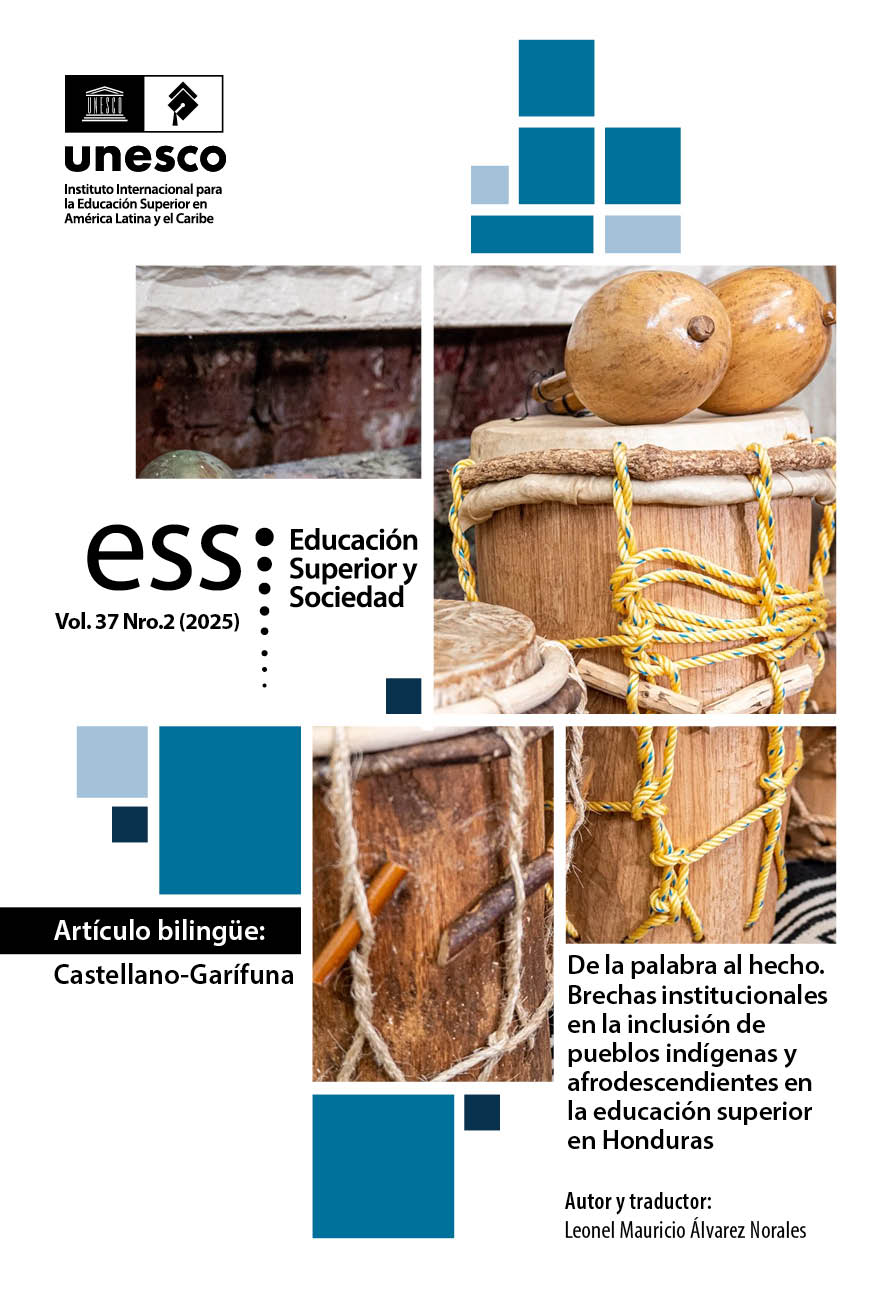
From Words to Deeds: Institutional Gaps in the Inclusion of Indigenous and Afro-Descendant Peoples in Honduran Higher Education
Abstract
This article examines the persistent gap between regulatory frameworks and institutional practices for the inclusion of indigenous peoples and Afro-descendants in higher education in Honduras. Although the last decade has seen a proliferation of policies, programs, and discourses aimed at equity, formal advances contrast with structural barriers that continue to limit access, retention, and graduation rates for students belonging to these communities. Using a hermeneutic-critical approach and a qualitative design, semi-structured interviews were conducted with university management representatives, and a documentary analysis of institutional policies, state agendas, and educational regulations was carried out. The results reveal statistical inconsistencies in population characterization, the weakening of state structures responsible for ethnic affairs, and the fragmented implementation of inclusion policies. Although institutions such as UNAH, UNAG, and UPNFM have developed some relevant initiatives, these lack systemic coordination, sustained resources, and evaluation mechanisms. The study identifies manifestations of institutional racism, expressed in bureaucratic practices that dilute complaints, monocultural curricula, and the absence of operational protocols that guarantee the full exercise of rights. It concludes that effective inclusion requires the articulation of recognition, redistribution, and epistemological reconfiguration through sustained budgeting, institutional units with executive mandates, teacher training in interculturality, the incorporation of local languages and knowledge into the curriculum, and monitoring with indicators to evaluate impact and active community participation.
Copyright (c) 2025 Leonel Mauricio Álvarez Norales

This work is licensed under a Creative Commons Attribution-NonCommercial 4.0 International License.
Copyright notice
Copyright allows the protection of original material, and curbs the use of others' work without permission. UNESCO IESALC adheres to Creative Commons licenses in the open access publication of ESS. Specifically, texts published in this journal are subject to a Creative Commons Attribution-NonCommercial 4.0 International (CC BY-NC 4.0) license: ESS is an open access journal, which means that all content is freely available to the user or their institution. Users may read, download, copy, distribute, print, search or link to the full text of the articles, or use them for any other lawful purpose, without asking prior permission from the publisher or the author, always making sure to cite the author. Commercial use is not permitted. ESS requires authors to accept the Copyright Notice as part of the submission process. Authors retain all rights.
The full license can be found at https://creativecommons.org/licenses/by-nc/4.0/
 Attribution - NonCommercial (CC BY-NC 4.0)
This journal does not charge authors for the submission or processing of articles. The authors of the contributions will receive acknowledgment of receipt that the work has reached the Editorial Team of the Journal.

.png)