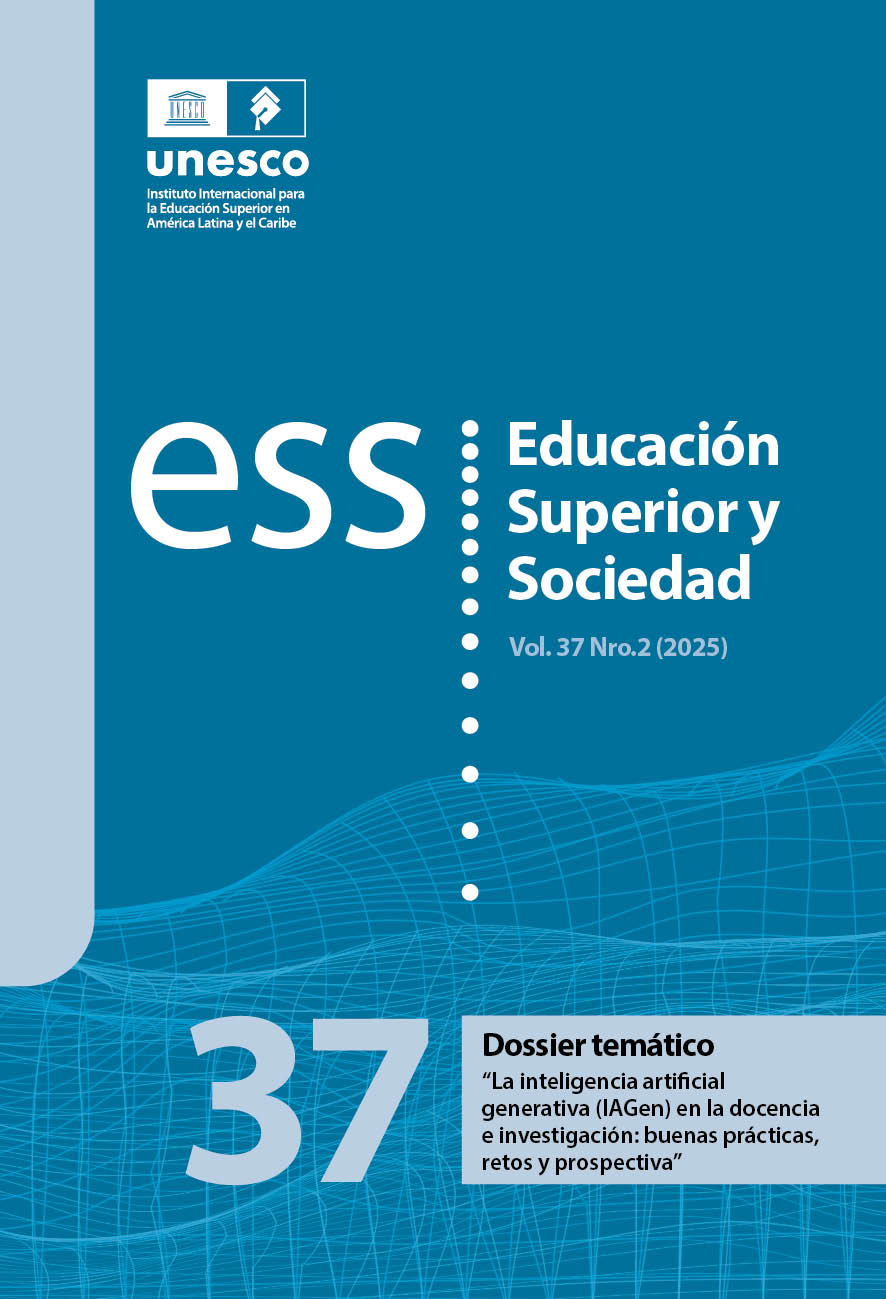
Authorship and Academic Integrity in the Age of Generative Artificial Intelligence in Higher Education
Abstract
This article analyzes the issue of academic integrity and the emerging forms of dishonesty derived from the use of generative artificial intelligence (GAI) in educational contexts, exploring how text-generation tools—such as advanced chatbots—are transforming traditional notions of authorship, originality, and academic plagiarism. The objective is to understand how generative AI challenges conventional conceptions of academic integrity and to propose ethical and institutional guidelines for its responsible use. Methodologically, a qualitative literature review was conducted, drawing on recent studies (2019–2024) addressing ethics, authorship, plagiarism, and technological equity in higher education. The findings show that AI introduces unprecedented ethical dilemmas: it redefines human authorship, complicates the detection of automated plagiarism, and may widen the digital divide between institutions with differing technological access. Emerging approaches to detecting AI-generated content and promoting transparency in human–AI collaboration are also identified. The conclusions highlight the need to strengthen digital ethics education, develop institutional policies regulating the academic use of AI, and ensure equitable access to its benefits through open-source tools, thereby fostering critical reflection on authorship and intellectual responsibility in the age of generative artificial intelligence.
References
Bearman, M.; J. Ryan; R. Ajjawi (2023). Discourses of Artificial Intelligence in Higher Education: A Critical Literature Review. Higher Education, 86(2), 369-385. https://link.springer.com/article/10.1007/s10734-022-00937-2
Bowen, J.; C. Watson (2024). Is it time to turn off AI detectors? Teaching with AI: A Practical Guide to a New Era of Human Learning [Feature article]. USA: American Association of Colleges and Universities. Published with permission of Johns Hopkins University Press.
Chaka, C. (2023). Detecting AI content in responses generated by ChatGPT, YouChat, and Chatsonic: The case of five AI content detection tools. Journal of Applied Learning & Teaching, 6(1), 94-104. https://doi.org/10.37074/jalt.2023.6.2.12
Chan, C. (2023). A Comprehensive AI Policy Education Framework for University Teaching and Learning. International Journal of Educational Technology in Higher Education, 20(1), 38. https://dialnet.unirioja.es/servlet/articulo?codigo=9062973
Clemente Alcocer, A. A., Cabello Cabrera, A., & Añorve García, E. (2024). La inteligencia artificial en la educación: desafíos éticos y perspectivas hacia una nueva enseñanza: LATAM Revista Latinoamericana De Ciencias Sociales Y Humanidades, 5(6), 464 – 472. https://latam.redilat.org/index.php/lt/article/view/3019
Costa, C.; M. Aparicio; S. Aparicio; J. Aparicio (2024). The Democratization of Artificial Intelligence: Theoretical Framework. Applied Sciences, 14(18), 8236. https://doi.org/10.3390/app14188236
Dehouche, N. (2021). Plagiarism in the age of massive Generative Pre-Trained Transformers (GPT-3). Ethics in Science and Environmental Politics, (21), 17-23. https://www.int-res.com/articles/esep2021/21/e021p017.pdf
Digital Education Council (2024). What students want: Key results from DEC Global AI Student Survey 2024. Digital Education Council (DEC). https://www.digitaleducationcouncil.com/post/what-students-want-key-results-from-dec-global-ai-student-survey-2024
Gallent, C.; A. Zapata; J. Ortego (2023). El impacto de la inteligencia artificial generativa en educación superior: una mirada desde la ética y la integridad académica. RELIEVE - Revista Electrónica de Investigación y Evaluación Educativa, 29(2). https://doi.org/10.30827/relieve.v29i2.29134
Gervais, D. (2020), Is Intellectual Property Law Ready for Artificial Intelligence? GRUR International, 69(2), 117-118, https://doi.org/10.1093/grurint/ikz025
Jarrah, A.; Y. Wardat; P. Fidalgo (2023). Using ChatGPT in academic writing is (not) a form of plagiarism: What does the literature say? Journal of Communication and Media Technologies, 13(4), e202346. https://doi.org/10.30935/ojcmt/13572
Labrador-Fernández, J. G. (2023). Implicaciones éticas de la Inteligencia Artificial en las Ciencias de la Educación. Revista Arbitrada Interdisciplinaria Koinonía, 8(16), 1-3. Epub 16 de agosto de 2023.https://doi.org/10.35381/r.k.v8i16.2545
Liang, W.; M. Yükségönül; Y. Mao; E. Wu; J. Zou (2023). GPT detectors are biased against non-native English writers. Patterns, 4(10), 100676. (Preprint arXiv:2304.02819). https://arxiv.org/pdf/2304.02819
Linares, J. E. (2024, mayo). Los desafíos éticos de la inteligencia artificial. La Revista de la Universidad. https://unamglobal.unam.mx/global_revista/los-desafios-eticos-de-la-inteligencia-artificial/
Mah, C.; H. Walker; L. Phalen; S. Levine; S. Beck; J. Pittman (2024). Beyond CheatBots: Examining Tensions in Teachers’ and Students’ Perceptions of Cheating and Learning with ChatGPT. Education Sciences, 14(5), 500. https://doi.org/10.3390/educsci14050500
McGuire, A. (2023). Leveraging ChatGPT for Rethinking Plagiarism, Digital Literacy, and the Ethics of Co-Authorship in Higher Education. Irish Journal of Technology Enhanced Learning, 7(1), 21-31. https://doi.org/10.22554/ijtel.v7i2.131
Microsoft Education (2020). Ethical AI for Classrooms: A Guide for Educators. https://education.microsoft.com/en-us/resource/6d5d1280
Muñoz, J. (2024). La integridad académica (IA) vs. inteligencia artificial (IA). El Diario de la Educación. https://eldiariodelaeducacion.com/2024/01/24/la-integridad-academica-ia-vs-inteligencia-artificial-ia/
Navarrete, Z.; H. Manzanilla (2023). Una perspectiva sobre la inteligencia artificial en la educación. Perfiles Educativos, 45(Especial), 87-107. https://doi.org/10.22201/iisue.24486167e.2023.Especial.61693
Pavlik, J. (2023). Collaborating with ChatGPT: Considering the implications of Generative Artificial Intelligence for journalism and media education. Journalism & Mass Communication Educator, 78(1), 84-93. https://doi.org/10.1177/10776958221149577
Perkins, M. (2023). Academic Integrity Considerations of AI Large Language Models in the Post-Pandemic Era: ChatGPT and beyond. Journal of University Teaching & Learning Practice, 20(3), Article 7. https://doi.org/10.53761/1.20.02.07
Qadhi, S.; A. Alduais; Y. Chaaban; M. Khraisheh (2024). Generative AI, Research Ethics, and Higher Education Research: Insights from a Scientometric Analysis. Information, 15(6), 325. https://doi.org/10.3390/info15060325
Rudolph, J.; S. Tan; S. Tan (2023). ChatGPT: Bullshit spewer or the end of traditional assessments in higher education? Journal of Applied Learning & Teaching, 6(1), 342-363. https://doi.org/10.37074/jalt.2023.6.1.9
Tu, J.; H. Hadan; D. Wang; S. Sgandurra; R. Mogavi; L. Nacke (2024). Augmenting the author: Exploring the potential of AI collaboration in academic writing. In GenAI Workshop ’24. https://doi.org/10.17605/OSF.IO/FVTMQ
UNESCO (2021). Recomendación sobre la ética de la inteligencia artificial. https://unesdoc.unesco.org/ark:/48223/pf0000380455_spa
Wiese, L. J., Patil, I., Schiff, D. S., & Magana, A. J. (2025). AI ethics education: A systematic literature review. Computers and Education: Artificial Intelligence, 8, 100405. https://www.sciencedirect.com/science/article/pii/S2666920X25000451
Zawacki-Richter, O.; V. Marín; M. Bond; F. Gouverneur (2019). Systematic review of research on artificial intelligence applications in higher education – where are the educators? International Journal of Educational Technology in Higher Education, (16), art., 39. https://doi.org/10.1186/s41239-019-0171-0
Copyright (c) 2025 Zaira Navarrete-Cazales , Juan Crescenciano Cruz-Victoria , Héctor Manuel Manzanilla-Granados

This work is licensed under a Creative Commons Attribution-NonCommercial 4.0 International License.
Copyright notice
Copyright allows the protection of original material, and curbs the use of others' work without permission. UNESCO IESALC adheres to Creative Commons licenses in the open access publication of ESS. Specifically, texts published in this journal are subject to a Creative Commons Attribution-NonCommercial 4.0 International (CC BY-NC 4.0) license: ESS is an open access journal, which means that all content is freely available to the user or their institution. Users may read, download, copy, distribute, print, search or link to the full text of the articles, or use them for any other lawful purpose, without asking prior permission from the publisher or the author, always making sure to cite the author. Commercial use is not permitted. ESS requires authors to accept the Copyright Notice as part of the submission process. Authors retain all rights.
The full license can be found at https://creativecommons.org/licenses/by-nc/4.0/
 Attribution - NonCommercial (CC BY-NC 4.0)
This journal does not charge authors for the submission or processing of articles. The authors of the contributions will receive acknowledgment of receipt that the work has reached the Editorial Team of the Journal.
.png)