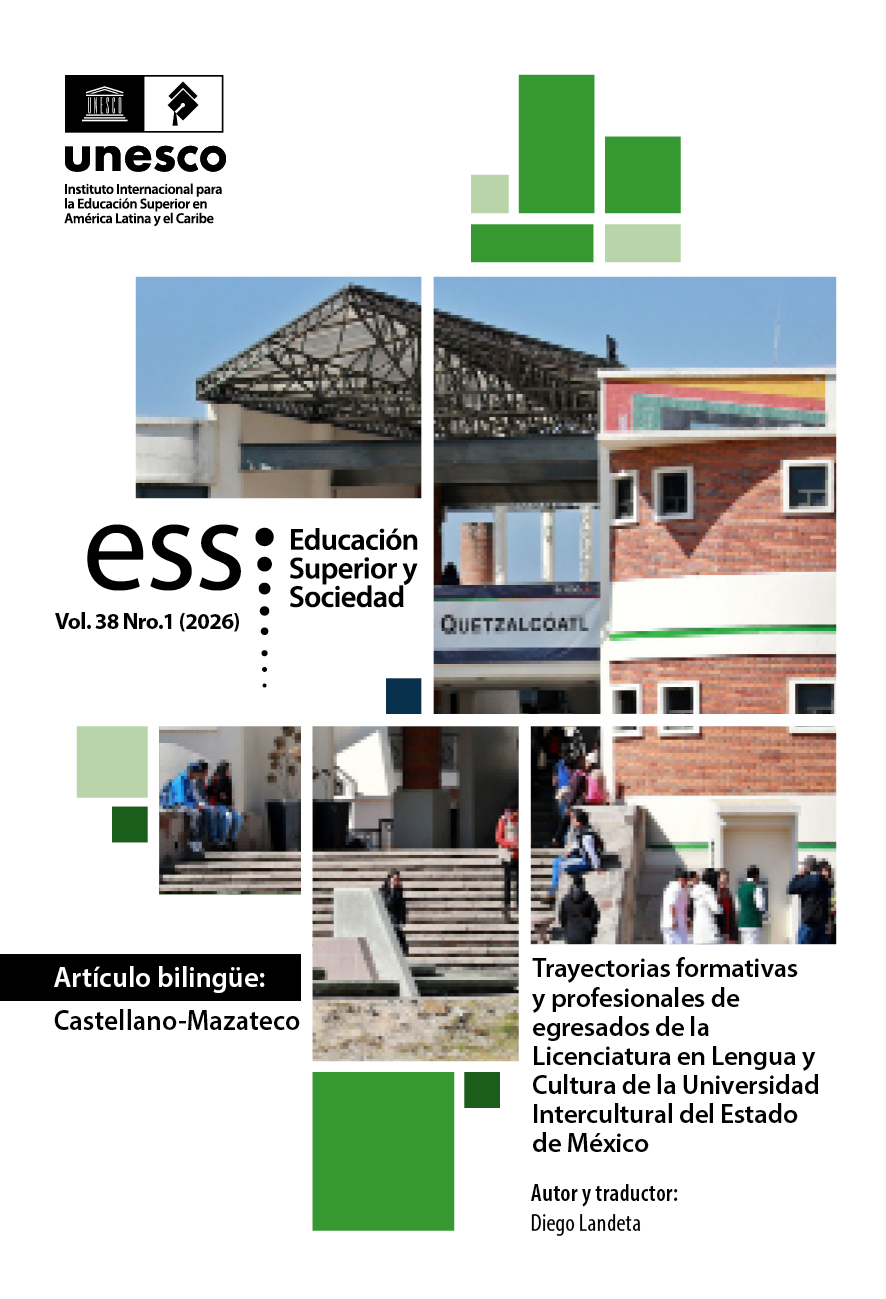
Educational and Professional Paths of Graduates from the Bachelor's Degree Program in Language and Culture at the Intercultural University of the State of MexicoEducational and Professional Paths of Graduates from the Bachelor's Degree Program in Language
Abstract
This paper presents the educational and professional experiences of graduates of the Bachelor’s Degree in Language and Culture program at the Intercultural University of the State of Mexico (LLyC-UIEM). It explores how, during their education, these graduates not only learn academic content but also connect their learning to language, identity, and community—understood as points of reference and spaces from which they construct and redefine their knowledge. The study does not analyze career trajectories solely as mechanisms for entering the workforce or achieving social mobility; rather, it examines how graduates connect and transform their university knowledge in relation to the knowledge, practices, and needs of their communities. It also considers the institutional conditions that facilitate or limit this connection, as well as the meanings that graduates attribute to their professional work. The research adopts a qualitative ethnographic methodology, developed through a horizontal and collaborative dialogue with Indigenous professionals who are graduates of this intercultural university.
Copyright (c) 2026 Diego Landeta

This work is licensed under a Creative Commons Attribution-NonCommercial 4.0 International License.
Copyright notice
Copyright allows the protection of original material, and curbs the use of others' work without permission. UNESCO IESALC adheres to Creative Commons licenses in the open access publication of ESS. Specifically, texts published in this journal are subject to a Creative Commons Attribution-NonCommercial 4.0 International (CC BY-NC 4.0) license: ESS is an open access journal, which means that all content is freely available to the user or their institution. Users may read, download, copy, distribute, print, search or link to the full text of the articles, or use them for any other lawful purpose, without asking prior permission from the publisher or the author, always making sure to cite the author. Commercial use is not permitted. ESS requires authors to accept the Copyright Notice as part of the submission process. Authors retain all rights.
The full license can be found at https://creativecommons.org/licenses/by-nc/4.0/
 Attribution - NonCommercial (CC BY-NC 4.0)
This journal does not charge authors for the submission or processing of articles. The authors of the contributions will receive acknowledgment of receipt that the work has reached the Editorial Team of the Journal.